
Two approaches with the same goal
If you’ve seen a chiropractor before, you may wonder what makes NUCCA different. It’s a fair question. Both traditional chiropractic and NUCCA upper cervical care are built on the same idea: the spine and nervous system work closely together, and helping the spine move and align well can help the body function better.
Traditional chiropractors help a great many people, and we respect the work they do. NUCCA is simply a more specialized path. At Ennis Chiropractic in Houston’s Clear Lake area, it’s the only care we provide, so we’re often asked to explain NUCCA vs. regular chiropractic. Here’s a clear, honest comparison.
The short version
| NUCCA upper cervical care | Traditional chiropractic (typical) | |
|---|---|---|
| Area of focus | The atlas (C1) and upper neck | Many areas of the spine, often the whole back |
| How the problem is found | Detailed exam plus specialized X-rays measured to fractions of a degree | Exam, palpation and motion testing; X-rays used in some cases |
| How the adjustment is planned | Calculated for your specific misalignment | Based on the doctor’s exam and clinical judgment |
| How it feels | Light, steady pressure behind the ear while lying on your side | Often a quick, hands-on thrust, sometimes with a popping sound |
| Twisting or cracking | None | Common, depending on the technique |
| How often you’re adjusted | Only when your measurements show you’ve shifted | Often at most visits |
| Checking results | Alignment rechecked after each correction; follow-up imaging when appropriate | Varies by practice |
| Long-term goal | A correction that holds longer, so you need fewer adjustments | Varies; often regular adjustments |
Every chiropractor practices a little differently, so think of the right-hand column as typical rather than universal.
Focus: one key area vs. the whole spine
Traditional chiropractic often looks at the spine as a series of joints that can each become stiff or restricted. The doctor may adjust the neck, mid back, low back and pelvis in a single visit.
NUCCA starts at the top. The atlas sits just below the skull and surrounds the brainstem as it becomes the spinal cord. When it shifts, the head can tip off center and the rest of the spine compensates below it. NUCCA doctors correct the atlas first, so the rest of the body can rebalance on its own. It’s a bit like fixing the master breaker in an electrical panel instead of resetting each tripped switch.
Measurement: calculated vs. felt
Traditional chiropractors are highly skilled at finding restricted joints by touch and movement. Some also use X-rays, especially after an injury.
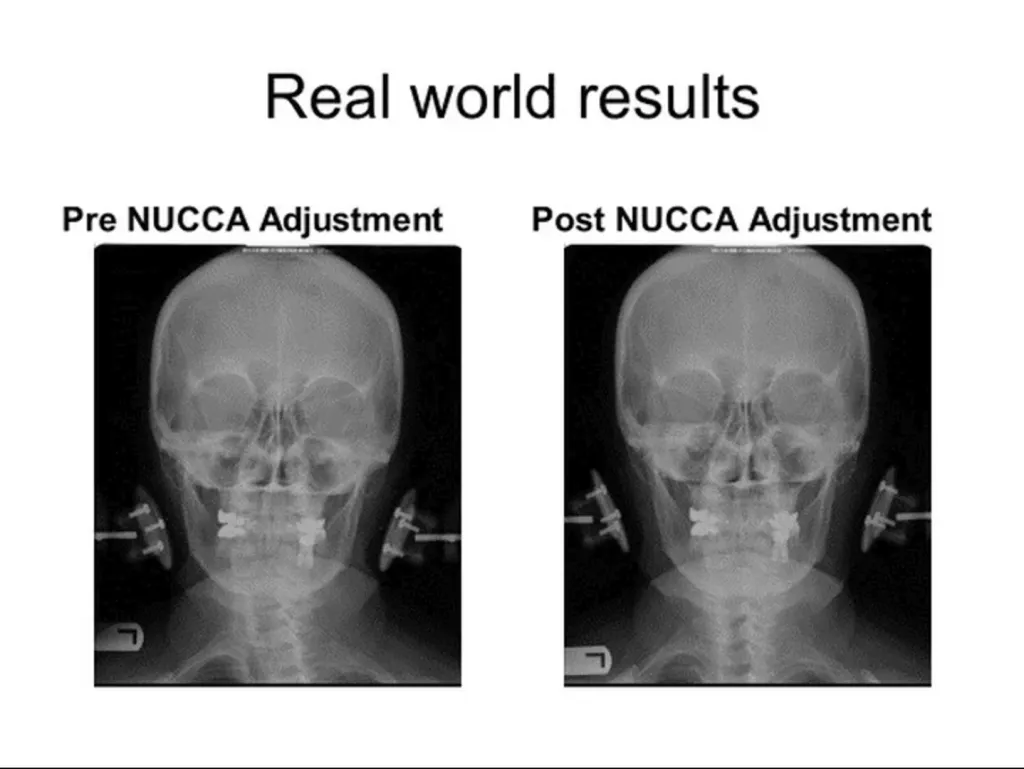
NUCCA relies on precise measurement. Before your first correction, we take specialized X-rays of the upper neck from several angles. From those images, your doctor calculates the direction and amount of force needed for your specific misalignment. We also check your alignment before and after each adjustment. You can read more in our article on why NUCCA doctors measure before adjusting.
Feel: gentle pressure vs. quick movement
A traditional adjustment often uses a fast, controlled thrust. Many people find it comfortable and enjoy the release they feel afterward. Others feel uneasy with neck twisting or the popping sound.
A NUCCA correction feels very different. You lie on your side, your head resting on a firm support, while your doctor applies a light, steady pressure just behind your ear. There’s no twisting and no popping or cracking. Because it’s so gentle, we routinely care for infants, children and seniors, as well as people who’ve felt nervous about chiropractic in the past.
Frequency: adjust when needed vs. on a schedule
In many traditional practices, you’re adjusted at most visits. In NUCCA care, we check first. If your measurements show you’re still holding your correction, we don’t adjust. The goal is for your body to hold its alignment longer over time, so visits can be spaced further apart. That’s how NUCCA care is meant to work: fewer adjustments, not more.
What the two approaches share
For all their differences, NUCCA and traditional chiropractic have a lot in common. Both are practiced by Doctors of Chiropractic who complete years of training in anatomy, neurology and diagnosis. Both look for problems in how the spine moves and aligns, and both respect the close link between the spine and the nervous system. Both also start with a health history and exam, and a good doctor in either field will tell you when you need a different kind of care.
NUCCA builds on that shared foundation with additional, specialized training in analyzing and correcting the upper neck. If you’ve had a good experience with chiropractic before, many of the basics will feel familiar. The correction itself is what will feel new.
Which is right for you?
There’s no single answer. Traditional chiropractic may be a great fit for general back stiffness or if you enjoy that style of care. NUCCA may be worth exploring if:
- Your symptoms center on your head, face or neck, such as vertigo, headaches or trigeminal neuralgia
- Your problems began after a fall, car accident or sports injury
- You’ve had other care that helped for a while, but the relief didn’t last
- You’d prefer care without twisting, popping or cracking
The best way to know is an exam. Learn more about our approach on the NUCCA upper cervical care page, read the basics in What is NUCCA?, or start with a $79 new patient visit. If NUCCA isn’t the right fit, we’ll tell you honestly.