
Precision starts with a question
Imagine a carpenter cutting a board without measuring it first. Even a skilled one would be guessing. The same idea applies to your upper neck.
At Ennis Chiropractic in Houston, we practice NUCCA upper cervical care. The atlas, the top bone in your neck, can shift in several directions at once: tilted, rotated or shifted to one side. Every person’s misalignment is different. That’s why NUCCA care always starts with the same question: exactly how has your atlas moved? We answer it with measurements before we ever make a correction.
What makes the atlas worth measuring
The atlas is a small ring of bone that supports your head. The brainstem passes through it as it becomes the spinal cord. Nerve signals that help control posture, balance and muscle tone travel through this area, along with blood vessels and fluid that serve the brain.
When the atlas shifts, the head tips slightly off center. The body compensates by tightening muscles and shifting posture. Because the upper neck is so sensitive, small differences in how a correction is delivered can matter. A precise plan helps us use the lightest touch needed, in the right direction.
How we measure
Health history and exam
Measurement starts with listening. Your doctor reviews your symptoms, past injuries and health history. Then come non-invasive exams that help show whether your upper neck may be involved and how your body is compensating.
Precise imaging
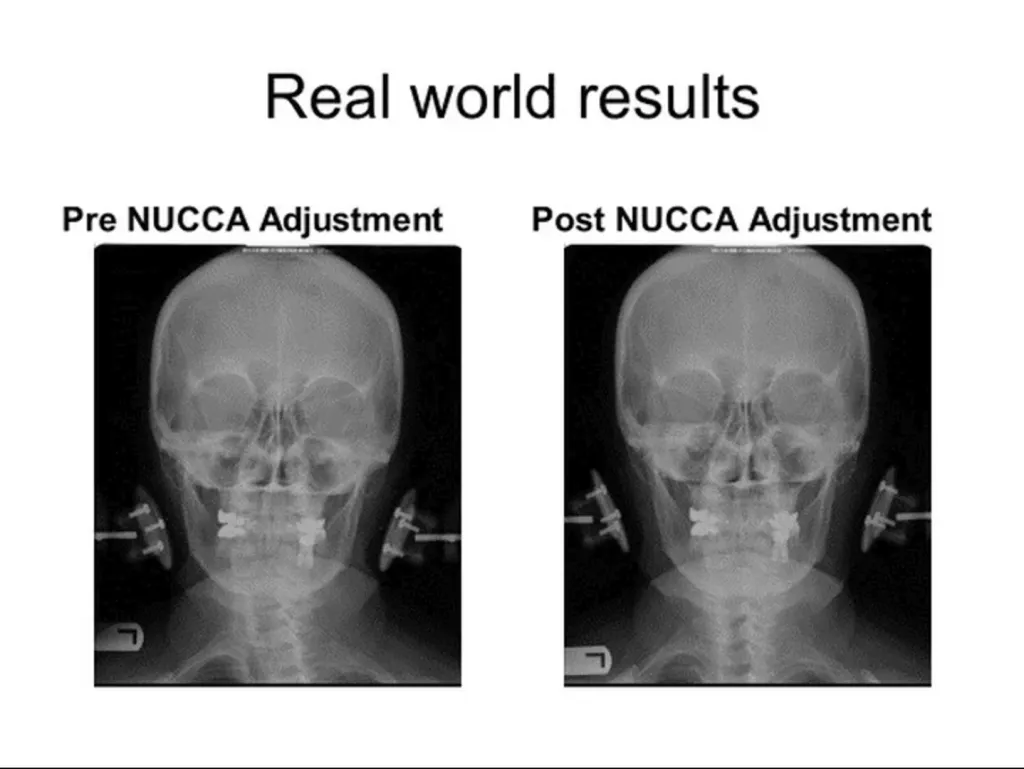
When NUCCA care is appropriate, we take specialized X-rays of the upper neck from several angles. These images let us measure your atlas position down to fractions of a degree. Your doctor then calculates the exact direction and depth for your correction.
Checks before and after each adjustment
At every visit, we check your alignment before deciding whether to adjust. After a correction, we check again to confirm it worked. When appropriate, we take post-correction images to compare with your original set.
Why measuring before and after matters
It makes the correction specific to you
Two people with the same symptoms can have very different misalignments. Measurements let us plan your correction for your anatomy, not a general pattern.
It keeps the force gentle
Knowing the exact direction means we don’t need force to get results. A NUCCA correction is a light, steady pressure just behind the ear. There’s no twisting, popping or cracking.
It shows whether the correction worked
Checking afterward lets both you and your doctor see what changed. You don’t have to rely only on how you feel that day.
It tells us when not to adjust
This may be the most important benefit. If your checks show you’re still holding your correction, we don’t adjust. Unneeded adjustments can get in the way of your body stabilizing. Measuring first lets us adjust only when you need it.
It tracks progress over time
Over weeks and months, your measurements build a record of how well you’re holding. As you stabilize, visits can be spaced further apart.
What this means for different conditions
Precise measurement matters for anyone in NUCCA care, but patients with sensitive conditions often appreciate it most. People with vertigo and dizziness, trigeminal neuralgia or symptoms after a head injury, such as post-concussion syndrome, are often nervous about having their neck adjusted. Knowing the correction is planned and gentle can make a big difference in how comfortable they feel.
What you’ll see at your visit
You don’t have to take our word for any of this. During your report of findings, your doctor will walk you through your own images and measurements, point out how your atlas has shifted and explain the plan for your correction in plain English. After each correction, we’ll show you what changed. Many people find that seeing their own numbers makes the whole process feel less mysterious.
Measuring is how we stay honest
Measurements also keep us accountable. If your exam doesn’t suggest that the upper neck is contributing to your symptoms, we’ll tell you. If your measurements show you’re doing well, we’ll tell you that too. You’ll always see your findings and understand your plan before care begins.
To learn more about the full process, visit our NUCCA upper cervical care page or see how NUCCA compares in NUCCA vs. traditional chiropractic.
See your own measurements
Curious what your upper neck looks like? Start with a $79 new patient visit at our Clear Lake office. It includes a health history review, non-invasive exams, a one-on-one consultation and, if NUCCA is a good fit, a personalized care plan with clear pricing. Call (281) 218-7571 with any questions.